Tennessee Dog Registration Information
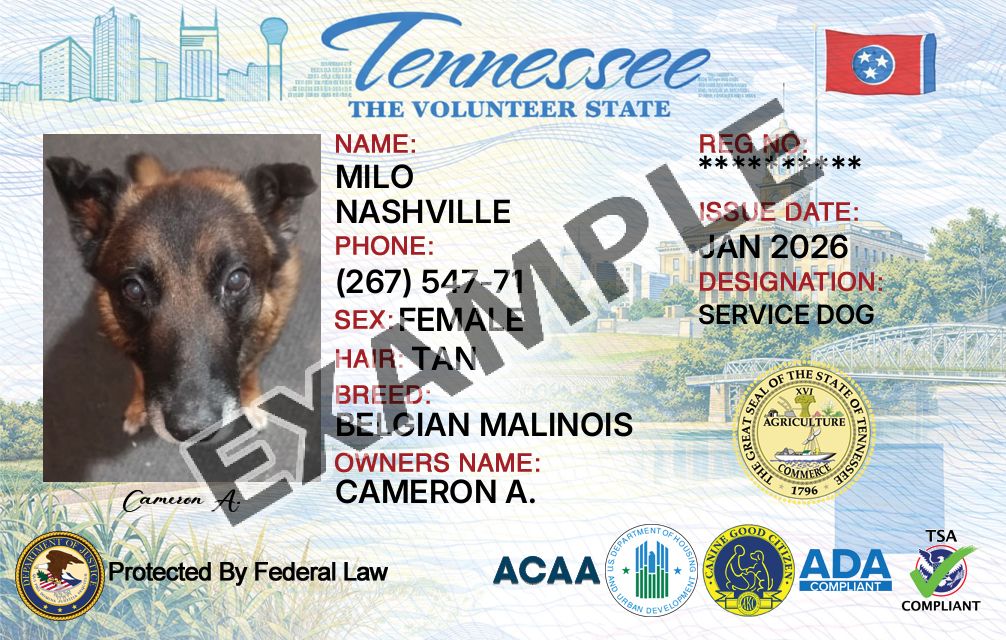
State Licensed, Service Dogs and Emotional Support Dogs in Tennessee
Overview of Dog Licensing in Tennessee
If you’re searching for where do I register my dog in Tennessee for my service dog or emotional support dog, the most important thing to know is this: Tennessee generally does not have one statewide “service dog registration” or “ESA registration” office. Instead, what most people call “registration” is usually a local dog license or rabies tag/animal registration handled by your county or city animal control, local health department, or a contracted municipal shelter.
In practical terms, getting a dog license in Tennessee is typically tied to your dog’s current rabies vaccination. Many Tennessee jurisdictions use a rabies vaccination record plus a local tag (often called a “rabies tag,” “registration,” or “license”) to identify your dog and connect the pet to you as the owner. That local tag can also help with reclaiming a lost dog and meeting boarding/daycare requirements.
Where to Register or License Your Dog in Tennessee
Because an animal control dog license Tennessee process is usually local, the right place to register depends on where you live (county/city). Below are several example official offices in Tennessee that publish rabies/animal control or licensing/registration details. Use these as models to identify the correct office for your address.
Metro Animal Care and Control (Nashville-Davidson County)
Address: 5125 Harding Pl
City/State/ZIP: Nashville, TN 37211
Phone: 615-862-7928
Office hours:
Adoption Hours: Friday–Wednesday 12:00 p.m.–4:00 p.m.; Thursday 12:00 p.m.–6:00 p.m.
Reclaim Hours: Seven days a week 12:00 p.m.–4:00 p.m.
Stray Animal Drop-Off: Seven days a week 12:00 p.m.–4:00 p.m.
Shelby County Health Department — Rabies Control (Shelby County)
Address: 1826 Sycamore View Road
City/State/ZIP: Memphis, TN 38134
Phone: 901-222-9715
Email: (Not listed on the referenced office page)
Office hours: Monday–Friday 7:00 a.m.–4:30 p.m.
Hamilton County Health Department — Rabies Program (Hamilton County)
Address: (Not listed on the referenced rabies program page)
Phone: 423-209-8110
Email: (Not listed on the referenced rabies program page)
Office hours: (Not listed on the referenced rabies program page)
Williamson County Animal Center (Williamson County)
Address: 1006 Grigsby Hayes Court
City/State/ZIP: Franklin, TN 37064
Phone: 615-790-5590
Email: (Not listed on the referenced contact page)
Office hours: Mon–Fri 10:00 a.m.–6:00 p.m.; Saturday 11:00 a.m.–3:00 p.m.
How Dog Licensing Works Locally in Tennessee
1) Tennessee is local-first for licensing and enforcement
Tennessee’s day-to-day pet regulation is typically enforced through local ordinances (county/city) and local agencies. Depending on where you live, the office responsible for dog licensing, animal control, or rabies enforcement may be:
- A county animal services or animal control department
- A city/metro animal control agency (especially in larger cities)
- A county health department program that handles rabies control, bite investigations, and tags
- A municipal shelter that provides services under contract with local government
This is why you’ll see different names used for similar things: “license,” “registration,” “rabies tag,” or “animal registration.” Even when the label differs, the goal is the same: connect the pet to its owner, confirm rabies compliance, and support animal control operations.
2) Rabies vaccination is the foundation of most local tags
Tennessee law makes it unlawful to own, keep, or harbor a dog (or cat) six (6) months of age or older that is not vaccinated against rabies, and rabies vaccination must be administered only by or under the supervision of a veterinarian. Dogs and cats may be vaccinated as early as three (3) months, but are considered noncompliant if over six months and not vaccinated.
Many local governments tie a local “license” to rabies vaccination status. For example, in Davidson County (Metro Nashville), registration is required for dogs and cats six months or older, requires a current rabies vaccination, and offers 1-year and 3-year tags that align with the vaccination term.
3) What you get: a tag/record (not a service dog certificate)
When you complete the local process, you typically receive a tag number and/or a tag to attach to your dog’s collar. This is often what apartments, boarding facilities, groomers, and animal control officers recognize as the local proof of compliance. However, it does not certify your dog as a service animal or emotional support animal. It’s simply a local identification and public health compliance tool.
4) A simple step-by-step for most Tennessee residents
- Confirm rabies vaccination is current (ask your veterinarian for a rabies certificate showing vaccination and expiration dates).
- Find your local issuing office (county health department, county animal control, or city/metro animal control).
- Ask what they call the process (dog license, rabies tag, registration) and what documents/fees apply.
- Submit proof and pay the fee (if applicable) to receive your tag/record.
- Keep copies of the rabies certificate and registration information for housing, boarding, and travel needs.
Service Dog Laws in Tennessee
Service dogs are not “registered” by the state
A common source of confusion behind “where do I register my dog in Tennessee for my service dog” is the assumption that there is a government registry. In reality, service dog status is a legal classification based on whether the dog is trained to perform tasks for a person with a disability and whether the dog meets behavior standards for public access. Your local dog license in Tennessee (rabies tag/registration) is still important, but it is separate from service dog status.
What agencies typically handle issues involving service animals
If there is a dispute about access in a business or public place, it’s generally handled through civil rights and disability access frameworks, not through animal control “registration.” Animal control and health departments usually focus on:
- Rabies vaccination compliance
- Licensing/registration tags (where applicable)
- Leash laws, nuisance complaints, bites, and dangerous dog processes
Practical guidance for Tennessee residents with a service dog
- Maintain local licensing/registration just like any other dog in your jurisdiction.
- Keep vaccination paperwork readily available.
- Focus on training and reliability: public access success depends on behavior and task training, not an online “certificate.”
Emotional Support Animal Rules in Tennessee
ESAs are different from service dogs
An emotional support animal (ESA) generally provides comfort by its presence, but does not necessarily perform trained tasks in the way a service dog does. This matters because ESA status typically applies most strongly in housing-related situations, while service dogs may have broader public-access protections under disability law.
There is no official Tennessee “ESA registration” office
If you’re asking where to register a dog in Tennessee for an ESA, the answer is usually: you register/license your dog locally for rabies compliance and identification, and you handle ESA documentation through the appropriate housing process (as applicable). Be cautious about third-party “registries” that sell certificates; they are not government licensing offices and are not required to make your dog an ESA.
What to do if your landlord asks for “registration”
Clarify what they mean. Many landlords use the word “registration” when they actually want one (or more) of the following: proof of rabies vaccination, a local rabies tag/license number (if your county/city issues one), or animal vaccination records from a vet. For ESA-related housing accommodations, ask what documentation they need to evaluate the request and provide what is appropriate and lawful for the situation.
Frequently Asked Questions
Do I need a dog license in Tennessee?
In Tennessee, many “licenses” are handled by local governments, not the state. Some counties/cities issue a formal dog license or rabies registration tag, while others may emphasize vaccination compliance and identification. Your best next step is to contact your county health department or local animal control and ask how licensing/registration works for your specific address.
Is rabies vaccination required in Tennessee?
Yes. Tennessee law makes it unlawful to own, keep, or harbor a dog (or cat) six months or older that has not been vaccinated against rabies, and vaccinations must be administered by or under the supervision of a veterinarian. Local jurisdictions can also have stricter rules.
Is a rabies tag the same thing as a dog license?
Often, yes in practice—especially where the “license” is tied to proof of rabies vaccination and results in a tag/registration record. But the exact terminology and process vary by county and city. If you’re unsure, ask the office directly whether their rabies tag/registration is what they consider the local dog license.
Where do I register my dog in Tennessee for my service dog?
You generally don’t register a service dog with the state to make it a service dog. Instead, you complete your normal local requirements (rabies vaccination and any local license/registration). Service dog status is based on disability-related need and training/behavior standards—not a purchased certificate or a county tag.
Where do I register my dog in Tennessee for an emotional support dog?
There is no official state ESA registry. You still follow local dog licensing/rabies rules, and ESA documentation is typically relevant to housing accommodation requests rather than animal control licensing.
What if I’m not sure which office covers my address?
Start with your county’s health department or animal control and ask who issues rabies tags/licenses for your municipality. In some areas, a city contracts services to a shelter, while the county handles enforcement in unincorporated areas.
What You May Need
- rabies vaccination proof
- identification
- proof of residency
- licensing fee
Quick Local Checklist (Tennessee)
- Confirm your dog’s rabies vaccination is current.
- Identify your city/county issuing office (animal control or health department).
- Ask whether they issue a “dog license,” “rabies tag,” or “registration.”
- Keep copies for housing/boarding and emergency reclaim purposes.
Register A Dog In Other Tennessee Counties
Select your county from the dropdown below to get started with your dog’s ID card. Requirements and license designs may vary by county, so choose your location to see the correct options and complete your pup’s registration.
- Anderson County Dog Registration
- Bedford County Dog Registration
- Benton County Dog Registration
- Bledsoe County Dog Registration
- Blount County Dog Registration
- Bradley County Dog Registration
- Campbell County Dog Registration
- Cannon County Dog Registration
- Carroll County Dog Registration
- Carter County Dog Registration
- Cheatham County Dog Registration
- Chester County Dog Registration
- City of Hartsville County Dog Registration
- City of Lynchburg County Dog Registration
- City of Nashville County Dog Registration
- Claiborne County Dog Registration
- Clay County Dog Registration
- Cocke County Dog Registration
- Coffee County Dog Registration
- Crockett County Dog Registration
- Cumberland County Dog Registration
- Davidson County Dog Registration
- Decatur County Dog Registration
- DeKalb County Dog Registration
- Dickson County Dog Registration
- Dyer County Dog Registration
- Fayette County Dog Registration
- Fentress County Dog Registration
- Franklin County Dog Registration
- Gibson County Dog Registration
- Giles County Dog Registration
- Grainger County Dog Registration
- Greene County Dog Registration
- Grundy County Dog Registration
- Hamblen County Dog Registration
- Hamilton County Dog Registration
- Hancock County Dog Registration
- Hardeman County Dog Registration
- Hardin County Dog Registration
- Hawkins County Dog Registration
- Haywood County Dog Registration
- Henderson County Dog Registration
- Henry County Dog Registration
- Hickman County Dog Registration
- Houston County Dog Registration
- Humphreys County Dog Registration
- Jackson County Dog Registration
- Jefferson County Dog Registration
- Johnson County Dog Registration
- Knox County Dog Registration
- Lake County Dog Registration
- Lauderdale County Dog Registration
- Lawrence County Dog Registration
- Lewis County Dog Registration
- Lincoln County Dog Registration
- Loudon County Dog Registration
- Macon County Dog Registration
- Madison County Dog Registration
- Marion County Dog Registration
- Marshall County Dog Registration
- Maury County Dog Registration
- McMinn County Dog Registration
- McNairy County Dog Registration
- Meigs County Dog Registration
- Monroe County Dog Registration
- Montgomery County Dog Registration
- Moore County Dog Registration
- Morgan County Dog Registration
- Obion County Dog Registration
- Overton County Dog Registration
- Perry County Dog Registration
- Pickett County Dog Registration
- Polk County Dog Registration
- Putnam County Dog Registration
- Rhea County Dog Registration
- Roane County Dog Registration
- Robertson County Dog Registration
- Rutherford County Dog Registration
- Scott County Dog Registration
- Sequatchie County Dog Registration
- Sevier County Dog Registration
- Shelby County Dog Registration
- Smith County Dog Registration
- Stewart County Dog Registration
- Sullivan County Dog Registration
- Sumner County Dog Registration
- Tipton County Dog Registration
- Trousdale County Dog Registration
- Unicoi County Dog Registration
- Union County Dog Registration
- Van Buren County Dog Registration
- Warren County Dog Registration
- Washington County Dog Registration
- Wayne County Dog Registration
- Weakley County Dog Registration
- White County Dog Registration
- Williamson County Dog Registration
- Wilson County Dog Registration